
Background and History of Art Form
- Year of publication for artwork: 1887
- Genre/Style: Marina Romanticism
- Media/Medium: Oil on Canvas
- Dimension: 109 x 145 cm
- Location of Display: N/A
Background and History of Artist
- Full Name/Recognized Name: Ivan Aivazovsky (Russian-Armenian)
- Born Date of Artist: 29th July 1817
- Death Date of Artist: 5th May 1900
- Occupation: Painter & Drawer
- Movement: Marina Romanticism
Brief Overview/History of the Artwork
- Depicts the birth of Aphrodite, the Greek Goddess of Love and Beauty.
- Aphrodite was born from the churning seafoam and became the lover of Poseidon.
- A dramatic painting heightened by the limited color palette and dramatic use of water.
- Different shades and intensities of blue contrast sharply with the bright moonlight, illuminating the figure of Aphrodite as she is drawn up by winged cupids.
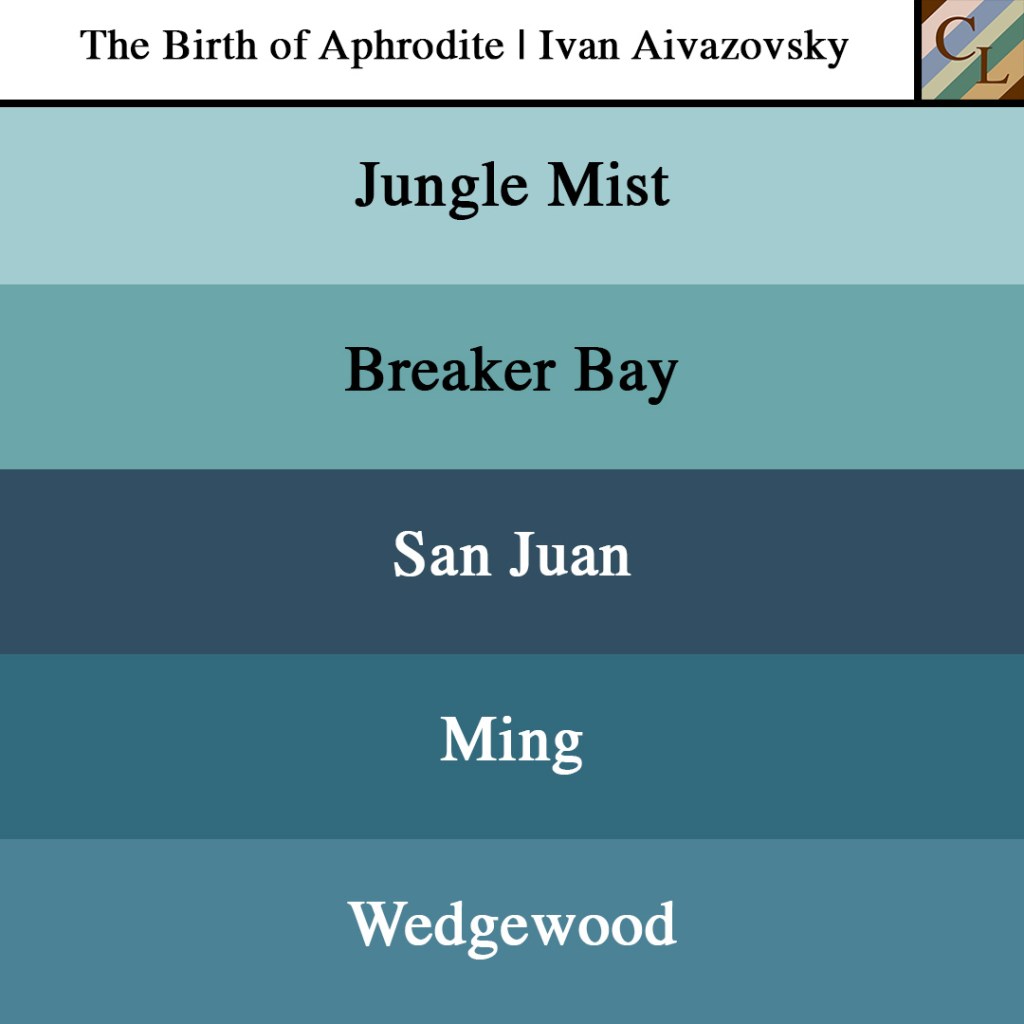
Analysis of the Colors/Theme
Viewing this painting, I decided to divide the painting into five distinct colors that highlight the presence of the blue of the oceans, the blue of the moonlight, and the blue of even the birth of Aphrodite herself. Let’s start with:
Jungle Mist introduces us to this omnipotent presence because it is the colors closest to the heavens. This is the lightest blue on the palette and was chosen for the reason of being a brighter color connected to the heavens or the gods. The lightness of Jungle Mist also serves as a focus point leading into the other blues and acting as a spotlight of the scene that is shown.
Breaker Bay is the next color closest to Jungle Mist when extending from the heavens. This color takes on the form of smoke coming from the heavens. This color is shown as an undertone throughout the painting, it seems to be a connective color between the ocean of the heavens and the oceans of earth.
San Juan is one of my favorite shades of blue, just the deepness of this blue shows a beautiful visual representation of the depth of the ocean and this can be seen within the painting. As Jungle Mist and Breaker Bay shed light onto the birth of Aphrodite, San Juan provides the background blue and by being the darkest it brightens the other blues of the palette.
Ming (which ironically is the nickname of my mother) is the second darkest blue shown within the palette and it serves as a bridge between the figures shown on the left and the birth of Aphrodite. The color Ming eases the viewer’s eyes from figure to figure, because of the darkness of the surrounding area and the figures themselves (apart from Aphrodite). What this amazing color does is it serves as a subconscious guide for the viewer from figure to figure.
Wedgewood represents the lightest colors that surround Aphrodite and some shades of Wedgewood can be found near Breaker Bay and Jungle Mist. Wedgewood is the color that is closest connected to the actual birth of Aphrodite, shown in the spotlight of the painting surrounding the Aphrodite figure.

Personal Viewpoint on the Artwork.
Personally, I like this painting. I think that Aivazovsky was smart in his decision of color choice and how it would add to the story. While viewing the painting you see this amazing birth of a goddess that is told through the light blues (such as Jungle Mist and Breaker Bay) but as your attention is diverted towards the painting as a whole, we get bits of dark and mundane feelings. As we all know, when hearing about gods and goddesses in mythologies there is always a light and dark side to their story, and I believe that this is beautifully told in the painting. Focusing on the painting alone (rather than the history of the mythology) when we see dark colors like Ming and San Juan it delivers a feeling of isolation, darkness, and despair. Usually, births are supposed to be a happy and joyous occasion but, the birth of gods—know that they will always represent both sides of the same coin.
References:
https://www.wikiart.org/en/ivan-aivazovsky/the-birth-of-aphrodite-1887
https://www.wikiart.org/en/ivan-aivazovsky
Next in Set A: Bathers by a River | Henri Matisse (1909-16)
 Chroma Illuminosity
Leave a comment