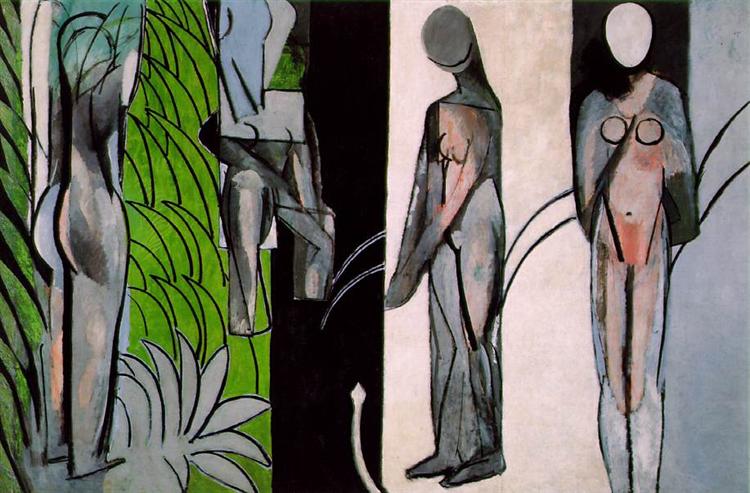
Background and History of Art Form
- Year of publication for artwork: 1909-1916
- Genre/Style: Cubism
- Media/Medium: Oil on Canvas
- Dimension: 260 x 390 cm (102.4 in x 153.5 in)
- Location of Display: Art Institute of Chicago, Chicago, IL, US
Background and History of Artist
- Full Name/Recognized Name: Henri Matisse (French)
- Born Date of Artist: 31st December 1869
- Death Date of Artist: 3rd November 1954
- Occupation: Painter, Draftsman, Collagist
- Movements: Fauvism, Neo-Impressionism, & Post Impressionism
Brief Overview/History of the Artwork
- Matisse regarded this picture as one of the most important in his career, and it is certainly one of his most puzzling, it was worked on for over eight years and passed through a variety of transformations.
- The painting evolved out of a commission from Matisse’s Russian patron, Sergei Shchuckin for two decorative panels on the subjects of dance and music. (Sergei Shchuckin: a Russian businessman who became an art collector, mainly of French Impressionist and Post-Impressionist art.)
- However, Matisse’s transformations gradually turned it into more of a confrontation with Cubism, and it is for this reason that the picture has been the subject of intense scrutiny.
- Although Matisse rejected Cubism, he certainly felt challenged by it is far more concerned with faithful representation of the structure of the human figure, and its position in space.
- This picture – along with many of Matisse’s works from 1913 to 1917 – seems to be influenced by the style, since it is very unlike his previous, more decorative work.
- The scheme for the picture resembled the idyllic scenes he had previously depicted in paintings such as Joy of Life (1905-06)**

Analysis of the Colors/Theme
Because of the complexity of a painting as such, I really had to spend some time figuring out and deciphering the meaningful connections behind some of the colors in the palette. Of all of the colors showcased throughout the painting’s color palettes, I was able to find five distinctive colors that uplift the painting and make it stand out. Since studying cubism itself is a difficult feat, understanding the colors of a painting that was refused but heavily influenced by cubism was going to be a task. As I analyze the colors within this painting, I sense the history of Matisse’s progression by viewing the artwork from left to right starting with:
Patina, which is shown in the upper left portion of the artwork. For a painting that is titled “Bathers by a River”, Patina is the brightest blue that is showcased in the painting and not to be confused with Bali Hai, which is the softest color in the palette. The small selection of Patina blue covers the head portion of the farthest human figure towards the left and one can see that that human figure has been painted over what seems like other lost shades of blue or grey. Patina showcases is a bridge, between the colors of the palettes and the history of the artwork and stands out in a part of the painting that has the most going on in terms of story or compositions. In the simplest understanding of the painting, Patina represents water. Patina also represents the initiation of the scene, indicating that is a visual of water being poured upon “bathers by a river”.
Moving onto this Christi green, when you think of a river and imagine the riverbank, I can imagine this is the green that Matisse was thinking of. Christi serves as the second introduction to the concept of the painting while being the base of what was part of the beginning stages of the artwork during its development. If the first introduction was blue, placing the left figure in between or in the composition of green grass, it provide more visual emphasis on the idea of all the figures taking a bath by the river. What I also like about this Christi green is that most of the colors that represent the image of the environment, water, or bathing take place in proximity to the Christi green and the blues.
Bali Hai is the name of one of my favorite, if not my favorite color guys. Just the name, the visual image, and the color itself is a beauty to the eyes and land itself a place in my top 5 favorite colors. About the artwork, Bali Hai serves as the second color of water and visually connects the water and the bathing figures. Bali Hai is seen mainly with Patina and Christi which emphasizes the “bathers/rivers” portion of “bathers by a river”. The softness of Bali Hai blends the natural environment and the humanoid figures but in a different sense than Patina. Bali Hai softly transfers the environmental picture that has been painted on the left and communicates that with the depletion of color that is seen on the right side of the painting.
Oriental Pink focuses more on the “bathers” portion of the concept, mainly being seen in the humanoid figures of the painting. This pink is representative of human nakedness and vulnerability. Let us recognize that the figures on the right have more pink within them than the figures on the left. It is safe to assume that these figures are further away from the river (in concept) and the right portion of the painting may be the newer side. Wherever we see speckles of pink is where I begin to see Matisse’s struggle with its Cubism interpretation, but these are the moments where I can feel movement from the figures in a scene that is being painted.
Nevada represents the overall movement of the painting and it takes on a lot of the transformation that we see going on in the painting. As the figures and their distinctive colors move in the foreground of the painting, in between the lines this Nevada gray, moves the scene along in the background. The main evidence of this movement can be seen within the figures themselves. As each figure is tied to a different color that “moves” they have a baseline color of greys/blacks which creates a pillar of visual immobility for the rest of the figure to move with the viewer’s eyes.

Personal Viewpoint on the Artwork.
Whew! This painting was a bit more intricate to talk about than the others. Since the artist himself was fighting internal creative and psychological conflicts, it makes the painting took on some of the characteristics of Matisse’s mind. Nonetheless, I believe that Matisse was able to artistically and a bit intelligently express himself in a way that showcases some of the internal creative turmoil he was dealing with. Throughout the painting, I think my favorite concept to grasp was the darkness amongst the light and soft colors of his narratives. With the use of his color palettes, he places focus on “the bathers”, “the river”, and “the bathers by the river”.
Reference
https://www.wikiart.org/en/henri-matisse/bathers-by-a-river-1916
https://www.theartstory.org/artist/matisse-henri/
Next in Set A: La Femme au Cheval | Jean Metzinger (1911-12)
 Chroma Illuminosity
Leave a comment