Woman with Horse
Background and History of Art Form
- Year of publication for artwork: 1911 – 1912
- Genre/Style: Analytical Cubism
- Media/Medium: Oil on Canvas
- Dimension: 162 cm × 130.5 cm (63.8 in × 51.2 in)
- Location of Display: Statens Museum for Kunst- Copenhagen, Denmark.
Background and History of Artist
- Full Name/Recognized Name: Jean Metzinger
- Born Date of Artist: 24th, June 1883
- Death Date of Artist: 3rd November 1956
- Movement: Neo-Impressionism, Divisionism, Fauvism, Cubism.
Brief Overview/History of the Artwork
- Also known as “Woman with a Horse.”
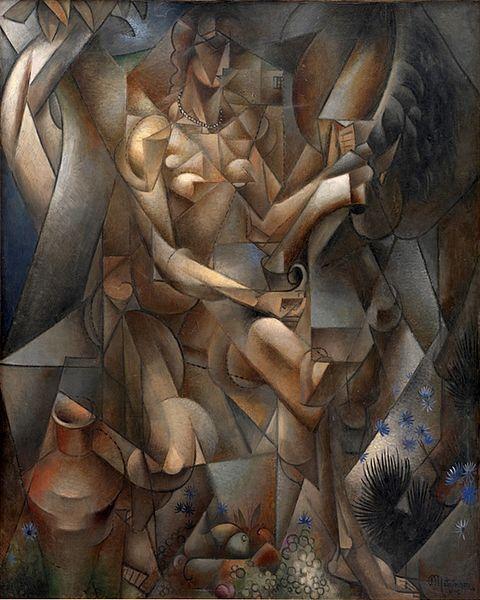
- The rather elegant woman wearing only a pearl necklace and the horse are immersed in a landscape with trees and a window (in the ‘background’), a vase, with fruits and vegetation (in the ‘foreground’) clearly taken from the natural world.
- Conceived in such a way that the viewer is obliged to contemplate the manifold surface of the painting for an extended period of time, piecing together the recognizable forms, not just in space, but in time.
- More obscure structures become legible with the topological context of the multi-dimension space of the whole. (Topology: anatomical structure of a specific area or part of the body).
- The radical new concept based on a non-conventional precept of space and time transformed the canvas from something quasi-static to something that possessed dynamic evolutionary characteristics.
- Metzinger’s Woman with a Horse is composed of a series of ellipses, curvilinear and rectilinear structures and planes juxtaposed and distributed throughout the canvas in myriad complex combinations of abstract volumetric forms that suggest rather than define the underlying subject.
- In this painting, Metzinger has broken down the picture plane into facets, presenting multiple aspects of the subject in succession and/or simultaneously.
- This concept first pronounced by Metzinger in 1910 would soon find its way into the foundations of the Copenhagen interpretation of quantum mechanics.

Analysis of the Colors/Theme
Within Metzinger’s artwork, we are greeted with many moving visuals that take on a true representation of cubism. As we analyze the painting viewing its landscape with trees, fruits, and vegetation, we are greeted by a subtle palette that embraces that natural world with blues, greens, and earthy browns. Let’s take a look:
Chicago is seen in the background and is a representation of the trees and the omnipresence of the waving world and the moving parts. As all the other colors stand out, this Chicago stands as the background to the picture that is displayed, moving intertwined with the trees, the lady, and the horse. The uniqueness in Chicago’s movement can also be seen in the mane of the horse (towards the upper right side). As Chicago moves through the middle and top portion of the painting, the lower portion is left for the plants and vegetation.
Tan represents the woman and her horse, not separate but together. As they move against the dark browns of the trees, the color of Tan stands out by distinguishing the humanoid and animalistic movements of the main characters of the painting. As the painting moves and ebbs, the Tan remains consistent throughout the representation of the woman and how she blends in with the horse, it gives the illusion that the horse is also the color of the tan.
Jambalaya is the color that represents the darkness of the trees, the bark, and the vase that sits at the bottom. It’s hard to distinguish the browns from each other but I have a firm belief that the dark browns are more representative of the trees even though they might be mixed with the grey of the Chicago. You can also see the Jambalaya on the neck of the horse as well, it seems the section where the horse head lies, has a whirlpool of colors going on that causes it to be blended and morphed with the geometrical shapes that Metzinger uses.
Cloud Burst, which is the blues that can be seen towards the far and upper left, I believe is a beautiful representation of a waterfall that leads to the vegetation and fruitful harvest that can be seen at the bottom of the painting. Cloud Burst is a perfect name for this color because it appears like a burst of blue that appears on the right of the painting. As we look towards the flowers, they serve as the perfect balance to the bottom and lower right half of the painting.
Thatch Green is the fruitful representation of the vegetation and the fruits that are seen at the bottom of the painting. What this little bit of dark green does is that it pushes the idea of vegetation upwards. Since there is no green seen within the trees, the color palette relies on the green at the bottom of the painting to showcase some of that green in the eye corner of the viewer and on a scale such as 162 cm × 130.5 cm (63.8 in × 51.2 in) is would serve as a wonder for the eyes to keep referencing as they explore the painting more.

Personal Viewpoint on the Artwork.
Personally, Cubism is one of the most difficult paintings to try and understand because of the multiple perspectives that could come across the painting. I have interpreted the colors how I listed them here, however to another viewer Jambalaya and Tan could be switched around or not even a correct interpretation of the brown colors that are presented throughout the painting. Yet I stand firm in my interpretation of the colors. What I love most about this painting is the galloping motion that is shown throughout the woman and the horse, I also like the movement of the trees throughout the Chicago grey it gives the painting and the story more movement. The vegetation and the fruits were a nice addition to the painting as well completing the story, but I think La Femme au Cheval takes the focus of the painting overall.
References:
https://www.wikiart.org/en/jean-metzinger/la-femme-au-cheval-1912
https://en.wikipedia.org/wiki/La_Femme_au_Cheval
Next in Set A: Totes Meer (Dead Sea) | Paul Nash (1940-41)
 Chroma Illuminosity
Leave a comment